Sodium-ion batteries are leaving the stationary-storage niche for a simple reason: their weakest parameter has improved enough to stop disqualifying them from mobile products.
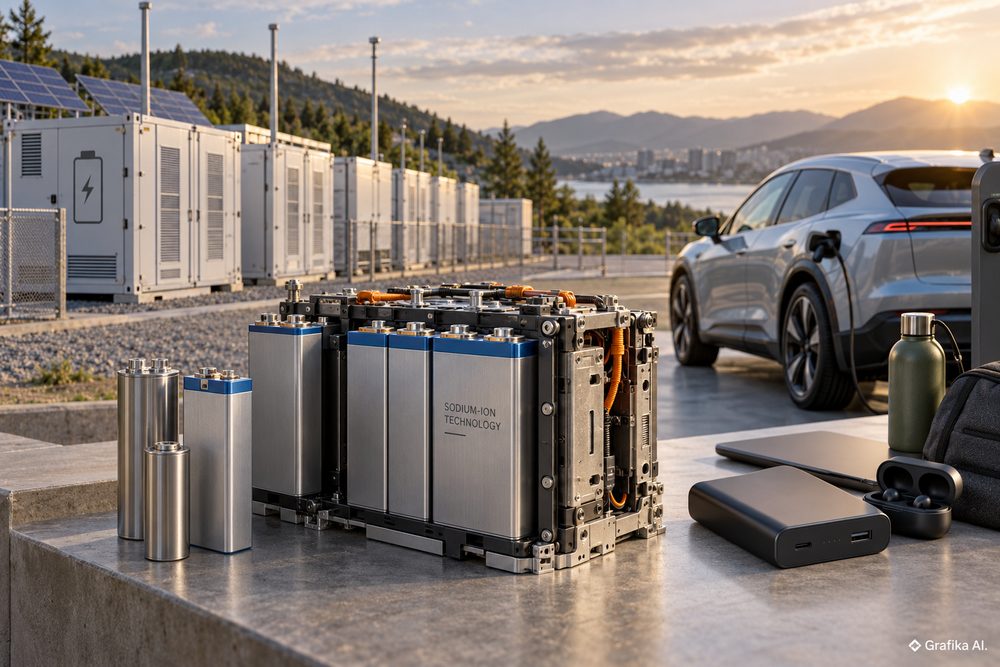
For years, sodium-ion chemistry made most sense in grid storage. A battery container sitting next to a solar farm does not care much whether its cells are slightly heavier or larger. Cars, power tools and portable electronics do. That is why energy density was the wall sodium-ion had to break through.
It has not caught lithium-ion completely. The latest commercial sodium-ion cells reach about 175 Wh/kg, while advanced LFP cells can reach roughly 205 Wh/kg and NMC cells about 265 Wh/kg. The gap remains significant, particularly where every kilogram and litre matter. But 175 Wh/kg is no longer a laboratory curiosity. It is enough for compact electric cars, commercial vehicles, starter batteries, power banks, industrial equipment and selected portable devices.
The important change is therefore not that sodium-ion has suddenly become “better than lithium.” It has become good enough in energy density while remaining unusually strong in cold-weather operation, cycle life and raw-material flexibility. Those characteristics create markets where a smaller battery does not need to beat lithium-ion on every specification to be the more rational choice.
The grid was the proving ground, but the performance gap has narrowed
A sodium-ion cell works broadly like a lithium-ion cell: ions shuttle between the cathode and anode during charging and discharging. The difference is the charge carrier. Sodium replaces lithium, while the anode is typically based on hard carbon rather than the graphite commonly used in lithium-ion batteries.
Cathode chemistry varies. Commercial developers are working with layered oxides, Prussian-blue analogues and polyanionic compounds such as sodium iron phosphate-based materials. That distinction matters because there is no single universal “sodium battery.” Cost, energy density, cycle life and dependence on metals such as nickel or manganese change with the cathode.
The attraction starts with materials. Sodium is abundant and geographically widespread. Some sodium-ion designs can also replace the copper anode current collector used in conventional lithium-ion cells with aluminium. In principle, that reduces exposure to several expensive or strategically concentrated materials.
That does not make every sodium-ion battery cheap.
This point is often lost in headlines. Lithium-ion manufacturing has had three decades to optimise factories, yields, supply contracts, pack architecture and recycling. LFP in particular has become brutally competitive. In 2025, the global average price of an LFP battery pack across applications was around $81/kWh, while stationary-storage packs averaged roughly $70/kWh. Against prices like those, sodium cannot win merely because salt is cheaper than lithium.
Scale is the real issue.
Global sodium-ion output in 2025 was still less than 1% of lithium-ion production. A young chemistry pays for smaller production runs, immature suppliers, lower factory utilisation and engineering problems that mature lithium-ion lines solved years ago.
CATL’s recent industrialisation work illustrates the less glamorous part of the transition. The company has identified manufacturing challenges including extremely tight moisture control, gas generation in hard-carbon anodes, adhesion to aluminium foil and anode-formation processes. Solving those problems is what turns a promising cell into something a vehicle manufacturer can order by the gigawatt-hour.
That process is now happening at serious scale. CATL says its sodium-ion technology has reached GWh-level industrialisation and is scheduled to enter full-scale production by the end of 2026. In stationary storage, the company has announced a 60 GWh, three-year sodium-ion supply agreement with HyperStrong and expects its first TENER Sodium deliveries in China during 2026.
Grid storage has therefore done more than provide sodium-ion with an easy first market. It has helped manufacturers build the production knowledge, suppliers and quality-control systems needed before the same chemistry can be trusted inside vehicles and consumer products.
There is one warning for European buyers and policymakers. Sodium reduces dependence on lithium, but it does not automatically create a European battery supply chain. More than 95% of installed and announced global sodium-ion cell manufacturing capacity through 2030 is currently associated with China. Europe has stronger access to several upstream materials, but cell manufacturing, cathode production and hard-carbon capacity remain heavily concentrated in China.
France’s Tiamat is one of the more important European attempts to change that. Its planned plant in the Hauts-de-France region is intended eventually to reach 5 GWh of sodium-ion cell capacity, initially serving applications including power tools, stationary storage, data centres and industrial systems. Stellantis has invested in the company, which is significant: European carmakers are not treating sodium merely as a laboratory backup anymore.
Cars are adopting sodium where range is not the only metric
The obvious objection to a sodium-ion electric car is weight. Put cells with lower Wh/kg into a vehicle and one of three things happens: range falls, the battery becomes heavier, or engineers must find space elsewhere.
That is why sodium-ion is not an obvious replacement for NMC in a 600-kilometre motorway SUV.
It becomes much more interesting when cold performance, power delivery, durability or cost stability matter more than maximum range.
CATL’s Naxtra technology illustrates the trade-off. Its current passenger-car cell is rated at up to 175 Wh/kg. The company says it retains more than 90% usable capacity at -40°C, can continue delivering power at temperatures as low as -50°C, and at -30°C can provide nearly three times the discharge power of an equivalent LFP battery.
Those numbers need context. A Polish driver is not routinely starting a car at -40°C. But the advantage matters well before reaching such extremes. LFP batteries lose power and usable energy as temperatures fall, and fast charging becomes more difficult when the cells are cold. Any chemistry that reduces that penalty can simplify winter thermal management and improve predictable range.
The first serious passenger-car programme arrived in 2026. Changan and CATL presented the Nevo/Qiyuan A06 with a 45 kWh Naxtra sodium-ion battery. The announced configuration targets more than 400 km of range under the manufacturer’s stated test conditions. That figure should not be read as a direct 400 km WLTP promise for a European-market car.
There is another distinction worth making: unveiling a “mass-production” vehicle is not the same thing as proving large-scale customer deliveries. As of late September 2026, the manufacturers have demonstrated a production-intent sodium-ion passenger-car programme and CATL has discussed deployment in thousands of vehicles, but sodium-ion cars are not yet a normal showroom option in Poland or the wider EU.
That makes the likely first automotive niches easier to identify:
-
Urban EVs and small cars: 250–400 km of practical range can be sufficient, while lower-temperature performance is valuable.
-
Delivery vans and municipal fleets: predictable routes reduce the need to carry a very large battery every day.
-
Vehicles in colder regions: winter power and energy retention can matter more than an extra 50–100 km in ideal weather.
-
Two- and three-wheelers: cost, cycle life and safety can outweigh maximum energy density.
-
12 V and 24 V auxiliary or starter batteries: high power and cold starting are more important than storing a large amount of energy.
-
Mixed-chemistry packs: sodium-ion cells can cover high-power or cold-weather duties while lithium-ion cells provide higher energy density.
The last option may be more important than a complete switch to sodium. CATL has openly developed dual-chemistry architectures. That approach treats battery chemistry as an engineering toolbox rather than a winner-takes-all contest.
It also avoids one of sodium-ion’s most irritating limitations: building an entire long-range pack around lower-energy-density cells simply to gain an advantage that is mainly needed during cold starts or high-power events.
Cycle life is another attraction, but numbers should be read carefully. CATL has stated that Naxtra can exceed 10,000 cycles. That is an exceptional specification on paper. No mass-market passenger-car fleet has been using these cells for enough years to provide a decade of independent field evidence, however. Buyers should separate laboratory or manufacturer cycle-life claims from long-term service records.
For a Polish fleet operator, the sensible question is therefore not “Is sodium better than lithium?” It is: How much range does the vehicle actually need on the coldest working day?
If a delivery van covers 120–180 km daily and returns to the same depot every evening, paying for a 500–600 km lithium-ion range can be unnecessary. If the vehicle regularly drives from Warsaw to Berlin at motorway speeds, lower energy density becomes much harder to justify.
Everyday electronics are a better fit than smartphones — at first
Consumer electronics expose sodium-ion’s strengths and weaknesses very quickly.
Elecom’s sodium-ion power bank is a useful real-world example because it is not a laboratory prototype. The device stores 9,000 mAh, supports USB Power Delivery with up to 45 W through USB-C, is rated for around 5,000 charge cycles and can discharge between approximately -35°C and 50°C.
That durability is attractive. If a power bank genuinely survives several thousand useful cycles, the battery is unlikely to be the first component that determines the product’s lifetime.
Then comes the compromise: it weighs roughly 350 g and measures about 87 × 31 × 106 mm.
That is heavy for a 9,000 mAh power bank. Mature lithium-ion models around the 10,000 mAh mark are routinely much lighter and slimmer. Sodium-ion therefore solves one problem while creating another. For something carried in a jacket pocket every day, users notice 100–150 additional grams immediately.
This is why the first wave of sodium-powered electronics is more likely to appear where longevity, safety, cold operation or frequent cycling matter more than minimum thickness.
Good candidates include power banks, emergency power units, UPS systems, professional tools, outdoor equipment, telecom backup units, portable industrial equipment and products that are charged and discharged several times per working day.
Flagship smartphones are a much tougher target. Phone manufacturers fight over fractions of a millimetre. A chemistry requiring more cell volume for the same watt-hours must deliver an exceptional advantage elsewhere to justify the sacrifice.
Laptops face a similar problem. A heavier battery reduces one of the features customers pay most for: portability. Sodium-ion could still make sense in rugged notebooks, industrial computers and equipment designed for outdoor winter use, but that is different from replacing the lithium-polymer pack in an ultrabook.
There is also an electrical-design issue. Sodium-ion cells commonly operate at a different voltage profile from familiar lithium-ion cells. A manufacturer cannot simply remove a lithium cell, insert a sodium cell of the same physical size and call the product finished. The battery-management system, charging profile, state-of-charge estimation and sometimes the series-cell configuration have to be designed for the chemistry.
Safety deserves similar precision. Sodium-ion is often described as “non-flammable,” which is too broad. Many sodium-ion batteries still use organic electrolytes, and any high-energy rechargeable battery requires protection against short circuits, overcharge, mechanical damage and excessive temperature. Some sodium chemistries show a lower tendency toward thermal runaway, but good cell chemistry does not replace good pack engineering.
For European consumer products there is another practical deadline. From 18 February 2027, EU Battery Regulation rules generally require portable batteries incorporated into products to be readily removable and replaceable by the end user, subject to specified exemptions. Recent exemptions cover certain categories where user replacement would conflict with safety or product requirements.
Sodium-ion does not bypass those rules. A manufacturer introducing a sodium battery into a power bank, tool or household device still has to design around European product safety, battery labelling, waste collection and replaceability requirements.
That could actually favour new battery chemistries in selected products. If a manufacturer already has to redesign a battery compartment, BMS and service strategy for the 2027 rules, changing chemistry becomes less disruptive than retrofitting an established sealed design several years later.
For buyers, the label “sodium-ion” should never be enough. Check six numbers before paying extra:
-
Energy in Wh, not only mAh. mAh is meaningless for cross-chemistry comparisons without voltage.
-
Total product mass, then compare Wh per kilogram.
-
Cycle-life definition, including the remaining capacity after the stated number of cycles.
-
Charging and discharging temperature ranges. A battery that discharges at -30°C may still require temperatures above 0°C for charging.
-
Maximum continuous output, especially for tools, UPS equipment and laptops.
-
Warranty and replacement availability. A 5,000-cycle cell has limited value inside a product whose electronics or connectors are unsupported after three years.
The European market should also be realistic about supply. Sodium is easy to source; finished sodium-ion cells are not yet equally diversified. A Polish company can design a sodium battery system without lithium, yet still end up depending on Chinese cathode material, hard carbon, cells or production equipment. That is a different supply risk, not the absence of one.
FAQ
Are sodium-ion batteries already cheaper than lithium-ion batteries?
Not consistently. Sodium has a potentially cheaper and more diversified raw-material base, but LFP manufacturing is extremely mature. In 2025, average LFP pack prices were around $81/kWh globally. Sodium-ion still carries the cost penalty of a smaller supply chain and lower production volumes. Its cost advantage should be judged at pack and lifetime level, not from the price of sodium alone.
Will sodium-ion replace LFP in electric cars?
Not across the market. LFP still offers better energy density at large industrial scale and has a mature global production base. Sodium-ion is more likely to take specific segments such as urban vehicles, cold-climate fleets, auxiliary batteries and mixed-chemistry packs.
Can I buy a mainstream sodium-ion electric car in Poland now?
Not as a normal mass-market choice as of September 2026. Production-intent vehicles have been presented in China, led by the Changan and CATL programme, but sodium-ion passenger cars have not yet become a regular Polish showroom category.
Are sodium-ion batteries better in winter?
This is one of their strongest current arguments. CATL’s latest cells are specified to retain more than 90% usable capacity at -40°C and to keep delivering power at even lower temperatures. Actual vehicle range still depends on cabin heating, tyres, speed, battery thermal management and the specific cell design.
Would a sodium-ion power bank be better than a lithium-ion one?
Choose it when cycle life, cold-weather use or reduced dependence on lithium matter more than size and weight. For everyday pocket use, lithium-ion still wins on compactness. The existing 9,000 mAh Elecom sodium-ion model weighs about 350 g, which makes the trade-off very visible.
Are sodium-ion batteries automatically safer?
No rechargeable battery is automatically safe. Sodium-ion can have favourable thermal behaviour and some chemistries are less prone to thermal runaway, but the pack still needs a competent BMS, temperature monitoring, over-current protection, mechanical protection and correct charging control.
What is the biggest obstacle to sodium-ion adoption in Europe?
It is no longer basic electrochemistry. The bigger problems are industrial scale, energy density and supply-chain concentration. Europe can source many sodium-related raw materials, but China currently dominates sodium-ion cell and component manufacturing and accounts for more than 95% of installed and announced global cell capacity through 2030.
If you are evaluating sodium-ion for a vehicle, product or procurement project, start with the required usable energy and the lowest real operating temperature. Calculate how many watt-hours are needed on the worst working day, then check whether the resulting sodium pack still fits the acceptable mass and volume. Only after that should cost, cycle life and sourcing decide between sodium-ion and LFP. The first mistake to remove is choosing a chemistry because its raw material sounds cheaper; in batteries, the cheapest element does not automatically produce the cheapest system.