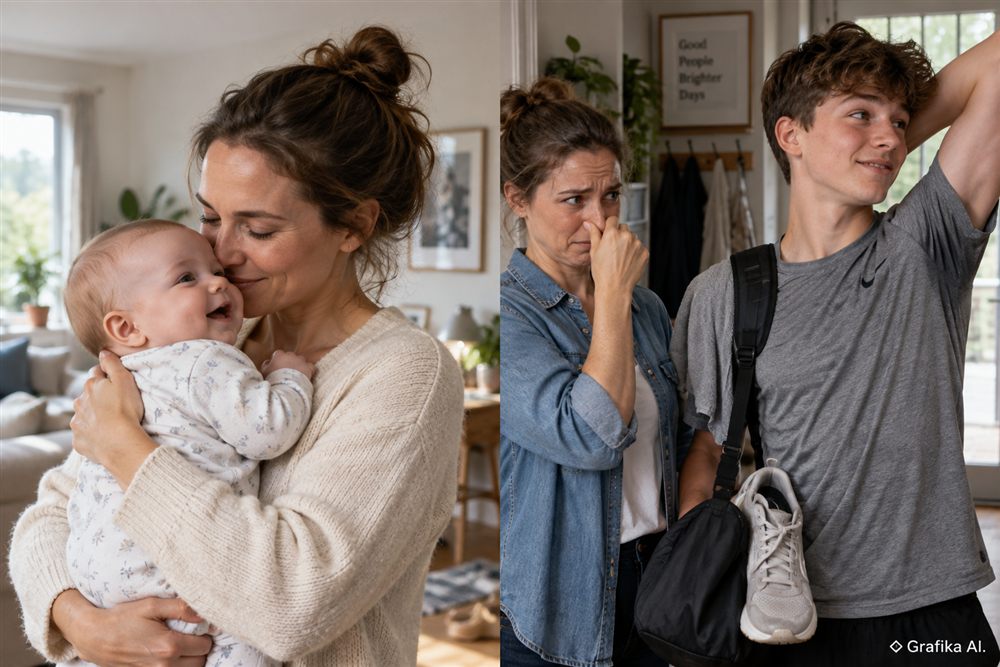
Babies tend to smell almost irresistibly good to their parents. Teenagers, not so much — and this is more than a family joke about sports shoes and bedrooms with poor ventilation. Research involving Polish parents found a clear relationship between a child’s age and how pleasant the parent rated that child’s natural body odor. In the youngest group, 93.7% of parents described their child’s smell as pleasant or very pleasant. After puberty, that figure dropped to 75.2%.
That study later earned an Ig Nobel Prize in 2026 for a team including Agnieszka Sorokowska and Tomasz Frąckowiak from the University of Wrocław, together with Ilona Croy and Thomas Hummel. One detail matters, though: the prize was awarded in 2026, but the study itself was published in 2017. That distinction is easy to lose in headlines, and it changes how the findings should be read.
235 parents, 367 children, and a steady decline with age
This was not a laboratory experiment in which parents were asked to sniff anonymous T-shirts or sealed odor samples. It was a questionnaire-based study, which is one of the most important limitations when interpreting the result. Parents rated the smell of their own children based on their everyday experience.
The researchers initially recruited 283 parents. Some were excluded from the final analysis, including people who reported impaired smell, parents who said they could not recognize their child’s odor, non-biological parents, and people who spent less than 10 minutes a day with the child.
The final sample included:
- 235 parents — 163 mothers and 72 fathers,
- parents aged 21 to 65, with an average age of 36.9,
- 367 children whose odor was evaluated,
- 184 girls and 183 boys,
- children aged from 1 month to 35 years, with an average age of 9.3 years.
Participants were recruited mainly in Wrocław and Brzeg in Poland, including at universities, courses, sporting events, and in public places. This means the sample was not representative of every family in Poland or Europe. The study is useful for showing a strong pattern within the group that was tested, but the exact percentages should not be treated as population-wide figures.
The children were divided into four age groups broadly corresponding to stages of development:
- under 4 years old — 79 children,
- 4–8 years old — 114 children,
- 9–14 years old — 68 children,
- over 14 years old — 105 children.
Parents rated odor pleasantness on a 0–20 scale. The average scores formed a clear progression:
- under 4 years old: 18.2 points,
- 4–8 years old: 17.4 points,
- 9–14 years old: 16.6 points,
- over 14 years old: 15.2 points.
The relationship between age and odor pleasantness was statistically significant. In plain terms, the older the child, the less pleasant the parent tended to rate the child’s natural smell.
The percentages make the effect even easier to see. 93.7% of parents of the youngest children described their child’s smell as pleasant or very pleasant. In the 9–14 group, that figure was 83.8%. Among children older than 14, it fell to 75.2%.
That last number is important because it prevents the result from being turned into a caricature. Three out of four parents of older children still rated their smell positively. The finding is not that teenagers suddenly become unpleasant to smell. A more accurate interpretation is that the unusually positive odor response associated with very young children gradually fades with age.
Interestingly, the 75.2% positive rating for older children was close to the figure for romantic partners: 76.7% of participants rated their partner’s smell as pleasant or very pleasant. So after puberty, a child’s scent may stop receiving the exceptional sensory “bonus” seen in infancy and early childhood.
Why babies smell better to parents: biology offers several plausible explanations
A baby’s smell is not processed by a parent in the same way as perfume, detergent, or a neutral household odor. Previous research has shown that mothers can recognize the smell of their own newborn very early after birth, and infant odor can activate brain regions associated with reward and motivation.
That fits a broader biological concept known as Kindchenschema, or “baby schema”: a set of infant features that tend to trigger caregiving responses. Large eyes, rounded cheeks, a proportionally large head, and soft facial features are the classic examples. Smell may be part of the same package.
From an evolutionary and behavioral perspective, the logic is straightforward. A very young child requires constant physical care: feeding, holding, cleaning, soothing, carrying, and close monitoring. If the infant’s smell is experienced as especially pleasant, close contact becomes more rewarding for the caregiver. That could support bonding and increase the likelihood of repeated nurturing behavior.
But there is an important boundary here. The 2017 study did not prove that a specific chemical in a baby’s scent causes stronger parental attachment. Researchers did not collect odor samples and identify individual compounds. They asked parents how pleasant they found their child’s smell.
So the study demonstrates a relationship between age and parental odor ratings. The explanation that pleasant infant scent supports bonding is biologically plausible and consistent with other work on olfaction, but it was not directly established by this questionnaire.
Puberty offers another strong clue. During adolescence, hormonal changes alter the activity of sweat and sebaceous glands, especially the apocrine glands, which become more active around puberty. Sweat itself is not necessarily strongly odorous. Much of what people recognize as “body odor” develops when skin bacteria break down compounds present in sweat and skin secretions.
That means the natural odor profile of a teenager is genuinely different from that of a toddler, even before deodorant, perfume, sport, footwear, or hygiene habits are taken into account.
The researchers also tested a more provocative hypothesis: whether the decline in odor pleasantness could be related to biological mechanisms that reduce the risk of sexual attraction between close relatives. If that were a major factor, a particularly strong effect might be expected in parent–child pairs of opposite sexes.
The data did not support that simple explanation.
There was no significant main effect of the parent’s sex or the child’s sex on the overall age-related decline. There was also no significant interaction showing that opposite-sex parent–child pairs behaved differently. In practical terms, the study did not provide evidence that the decline in pleasantness was primarily an incest-avoidance mechanism.
What the 2026 Ig Nobel actually recognized — and what the study does not prove
The Ig Nobel Prizes are known for rewarding research that first makes people laugh and then makes them think. The study on parental responses to children’s body odor fits that formula unusually well: the headline sounds comic, but the underlying question concerns bonding, development, puberty, sensory perception, and family relationships.
The 2026 award went to Ilona Croy, Tomasz Frąckowiak, Thomas Hummel, and Agnieszka Sorokowska. The Polish connection is especially strong because part of the research team was associated with the University of Wrocław, and the participant sample was drawn from Poland.
What matters more than the prize itself is understanding what the study can and cannot tell us.
First, it does not prove that teenagers objectively smell worse than younger children. The researchers measured parents’ subjective ratings, not chemical odor intensity, bacterial composition, or the concentration of specific volatile compounds.
Second, it cannot be used as a diagnostic tool for puberty. The children were grouped by chronological age rather than by individually measured pubertal stage. A 13-year-old can be at a very different stage of hormonal development from another 13-year-old, so age is only a rough proxy.
Third, the result is not a reason to push teenagers toward excessive deodorant use. If body odor becomes stronger during puberty, the sensible priorities are basic ones:
- shower regularly, especially after sport,
- change T-shirts, underwear, and socks daily,
- wash sportswear after use,
- let shoes dry properly instead of wearing the same damp pair every day,
- use an antiperspirant or deodorant if ordinary hygiene is not enough.
The main nuisance is usually not puberty itself but the combination of sweat, synthetic sports fabrics, repeatedly worn footwear, and bacterial buildup. Those are practical problems with practical fixes.
There is, however, a boundary where “teenage smell” should not be dismissed casually. A sudden or unusually strong change in body odor, especially if accompanied by weight loss, excessive thirst, fever, skin lesions, unusual sweating, or other symptoms, deserves medical attention. The Ig Nobel study says nothing about disease-related odor changes and should not be used to explain them away.
The most useful interpretation is therefore narrower and more interesting than the joke. Parents appear to give the smell of very young children an unusually high positive rating, and that effect steadily weakens as the child grows up. The real question is not why teenagers “smell bad,” but why babies smell so exceptionally good to the people caring for them.
FAQ
Was the Ig Nobel awarded for a study conducted in 2026?
No. The Ig Nobel Prize was awarded in 2026, but the study itself was published in 2017.
How many parents took part in the study?
The final analysis included 235 parents — 163 mothers and 72 fathers — who evaluated the smell of 367 children.
How many parents liked the smell of the youngest children?
Among children under 4, 93.7% of parents rated their smell as pleasant or very pleasant.
What was the result for older children and teenagers?
In the 9–14 age group, 83.8% of parents gave a positive rating. Among children older than 14, the figure was 75.2%.
Does the study prove that teenagers smell bad?
No. Even in the oldest group, about three in four parents still rated their child’s smell positively. The study shows a decline in pleasantness, not a switch from pleasant to unpleasant.
Did mothers react differently from fathers?
The study did not find a meaningful effect showing that mothers and fathers differed substantially in the age-related pattern.
Did the researchers actually smell the children?
Not in this study. It was a questionnaire study. Parents rated the natural smell of their own children based on everyday experience rather than laboratory odor samples.
Did the research prove that infant smell strengthens bonding?
No. That is a plausible biological interpretation supported by related olfactory research, but this particular study did not directly test whether infant odor causes stronger attachment.
What is the clearest takeaway?
The strongest finding is simple: the younger the child, the more pleasant parents tended to rate that child’s natural body odor, with the highest ratings in early childhood.