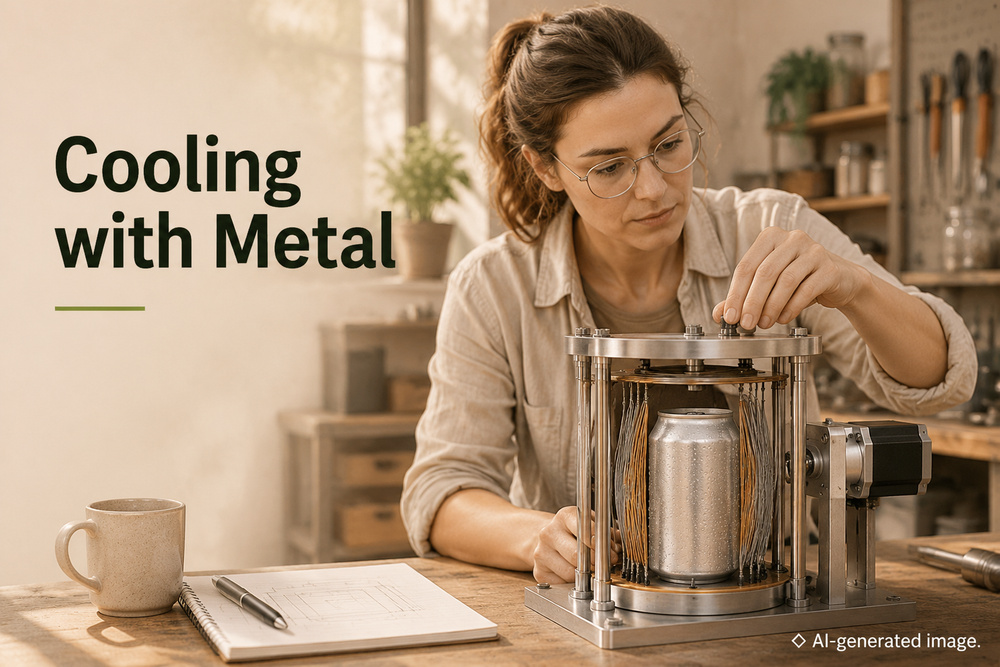
A drinks can can be cooled without a compressor, circulating refrigerant or conventional refrigeration cycle. The principle behind elastocaloric refrigeration is surprisingly simple: stretch a special metal alloy and it heats up; release the tension and it cools down. By repeating this process and transferring heat between two separate zones, engineers can move thermal energy away from a drink and into the surrounding environment.
The material responsible is usually nickel-titanium (NiTi), a shape-memory alloy already used in medical devices, engineering components and precision mechanisms. Its ability to change crystal structure under mechanical stress makes it particularly interesting for refrigeration. Instead of evaporating and condensing a fluid, the system uses a reversible transformation inside a solid metal.
This is no longer just a theoretical concept. Researchers at Saarland University in Germany have developed a functional elastocaloric mini-fridge designed around a 250 ml drinks can. The prototype demonstrates that a stretched metal wire can become the working material in a real cooling device. However, achieving a temperature change in a laboratory sample and reliably chilling a beverage are two different engineering challenges.
Why Stretching Nickel-Titanium Produces a Cooling Effect
The secret lies in the elastocaloric effect, a temperature change caused by mechanical stress and the resulting transformation of a material’s internal crystal structure.
Nickel-titanium can exist in two important phases:
- Austenite – the higher-temperature parent phase, which generally has a more symmetrical crystal structure.
- Martensite – a different crystal structure that forms when mechanical stress triggers a phase transformation.
When a suitable NiTi alloy is stretched under the right temperature and loading conditions, its austenite transforms into martensite. This transformation releases latent heat, causing the material’s temperature to rise. When the mechanical force is removed, the alloy returns towards its original austenitic structure and absorbs latent heat. Its temperature consequently drops below its initial value.
The complete refrigeration cycle requires four steps:
- Mechanical loading: An actuator stretches the NiTi element, triggering the martensitic transformation and increasing its temperature.
- Heat rejection: The warmer alloy transfers heat to the hot side of the system, typically through moving air or another heat-transfer medium.
- Mechanical unloading: The actuator releases the tension, allowing the reverse phase transformation and cooling the alloy.
- Heat absorption: The colder alloy absorbs heat from the air surrounding the drinks can. The cycle then repeats.
The distinction between the third and fourth steps is important. Releasing a stretched wire produces a temperature drop, but that alone does not refrigerate a drink. The system must first remove heat from the alloy on the hot side and then provide effective thermal contact with the cold side.
Temperature changes can reach several kelvin, depending on the alloy composition, initial temperature and applied mechanical stress. Some experimentally studied materials have demonstrated adiabatic temperature changes approaching 23 K. These are material-level results, not guaranteed temperature differences across a complete refrigerator.
NiTi is particularly attractive because of its superelastic properties and relatively good mechanical performance. However, it requires substantial stress to trigger the transformation. For typical NiTi compositions, tensile transformation stresses can be around 500 MPa, with some compression-based configurations requiring more than 800 MPa.
This creates an important design decision. A thinner wire improves the available heat-transfer surface relative to its volume, but it still needs a carefully controlled loading mechanism. Excessive stretching increases mechanical stress and accelerates fatigue. Too little stretching, on the other hand, produces a weaker phase transformation and less useful cooling.
The technology makes sense when engineers can combine reversible deformation, efficient heat exchange and controlled mechanical loading. Simply attaching a piece of shape-memory metal to a can and repeatedly pulling it will not produce a practical refrigerator.
How an Elastocaloric System Actually Cools a Drinks Can
One of the most interesting practical examples comes from the ECCube project, developed by researchers associated with Saarland University and the Center for Mechatronics and Automation Technology (ZeMA) in Germany.
The research, published in Frontiers in Materials in March 2025, describes an elastocaloric mini-fridge designed for a standard 250 ml beverage can measuring approximately 52 mm in diameter and 134 mm in height.
Its cooling mechanism uses bundles of very thin nickel-titanium wires rather than a single large metal component.
The main design parameters include:
| Component or parameter | Prototype specification |
|---|---|
| Alloy | Nickel-titanium (NiTi) |
| Wire diameter | 200 µm |
| Wire length | 150 mm |
| Number of wire bundles | 12 |
| Wires per bundle | 30 |
| Total number of wires | 360 |
| Total shape-memory alloy mass | 10.7 g |
| Rotation frequency | 0.5 Hz |
| Airflow rate in the simulation | 200 L/min |
| Mechanical strain range | 1–5% |
| Peak force per bundle | 650 N |
The wires are arranged around a rotating mechanical assembly. As the assembly moves, a cam mechanism stretches the wire bundles on one side and releases them on the other.
This creates two distinct thermal zones:
- The hot zone: Stretched wires heat up and transfer their excess thermal energy to incoming ambient air, which is subsequently discharged.
- The cold zone: Released wires cool down and exchange heat with circulating air directed through the chamber containing the beverage.
The air then carries heat away from the can’s surface. Continuous circulation gradually reduces the temperature of the enclosed space.
Using air instead of a sealed liquid cooling circuit simplifies the construction and avoids the additional components required to contain and circulate a liquid. The trade-off is that air transfers heat less effectively than water. The system therefore depends heavily on wire surface area, airflow velocity and the geometry of the ducts.
The research illustrates why seemingly small mechanical details matter. The design uses a combination of fans, rotating components and carefully separated air channels. Even unwanted air leakage between the hot and cold zones reduces the useful cooling effect.
The difference between simulation and actual performance is particularly revealing.
The researchers calculated that the system could deliver approximately 34.8 W of thermal power at an airflow rate of 200 L/min, with a simulated temperature difference of 8.7 K between the cold-air inlet and outlet. The model assumed 6 W of mechanical input, producing a calculated COP of 5.8.
However, that figure was not an experimentally verified system efficiency. The simulation excluded electrical consumption by the fans and did not account fully for air bypass and other losses.
Initial experimental measurements produced a temperature difference of approximately 3.5 K inside the cooling chamber, substantially below the simulated 8.7 K. The researchers identified imperfect sealing, thermal leakage between channels and insufficient insulation as important reasons for the difference.
There is also a practical question of how much energy is needed to chill the drink itself.
Consider a 250 ml water-based beverage initially at 22°C. Cooling it to 8°C requires approximately:
Q=mcpΔ T
Using a mass of 0.25 kg and a specific heat capacity of approximately 4.18 kJ/(kg·K):
Q=0.25 × 4.18 × 14
Q ≈ 14.6 kJ
To achieve this temperature reduction in 20 minutes, the cooling system would need to remove approximately 12.2 W of net heat from the beverage, excluding heat entering through the enclosure and other thermal losses.
This is a useful engineering target, not a demonstrated cooling time for the ECCube prototype. A measured 3.5 K difference in chamber air does not establish that the liquid inside the can has cooled by 14 K.
The development has continued. At Hannover Messe in April 2026, Saarland University presented a functional elastocaloric mini-fridge using bundles of 200-micrometre NiTi wires arranged around a circular cooling chamber. The demonstration showed the potential to cool an actual drinks can.
For this type of application, the most important design priorities are therefore:
- Increasing the contact area between the alloy and circulating air.
- Preventing warm exhaust air from leaking into the cooling chamber.
- Maintaining sufficient airflow without excessive fan power.
- Minimising the distance between the cooling elements and the can.
- Controlling the mechanical loading cycle to avoid unnecessary strain.
A compact air-based system makes sense for a small cooling chamber where simplicity and easy maintenance matter. A liquid-based heat-transfer arrangement becomes more attractive when greater heat-transfer capacity is needed and the additional plumbing, sealing and maintenance are justified.
Can Elastocaloric Refrigeration Replace Conventional Cooling Technology?
Elastocaloric refrigeration has several genuine advantages, but it is not yet a direct replacement for conventional refrigerators.
The most obvious benefit is the absence of a circulating vapour refrigerant. The cooling material remains solid throughout operation, so there is no conventional compressor circuit with refrigerant evaporation, condensation and associated leakage risks.
However, solid-state refrigeration does not mean a machine without moving parts. The actuator, cam mechanism, bearings, transmission and fans still require mechanical energy. These components introduce wear, vibration, manufacturing costs and maintenance requirements.
The biggest challenge is the combination of mechanical fatigue and system efficiency.
Mechanical fatigue and service life
Every loading and unloading cycle puts the shape-memory alloy under mechanical stress. Over time, repeated deformation can cause microcracks, residual deformation and deterioration of the phase transformation.
This is especially important in tensile-loaded wire systems. Tension makes it relatively straightforward to arrange thin wires around a cooling chamber, but it can encourage crack initiation and propagation.
Compression-based systems generally offer better fatigue resistance, although they require different mechanical arrangements and can demand higher operating forces.
The scale of the problem becomes clearer when considering operating time. A refrigerator running for 4,380 hours annually at a frequency of 1 Hz accumulates approximately 15.8 million cycles per year. Even the 0.5 Hz operating frequency modelled for the ECCube would produce nearly 7.9 million cycles over the same operating period.
Advanced shape-memory alloys have demonstrated stable operation beyond 10 million cycles, but that is not enough to establish a long service life for every household application. Material selection, strain limits, surface finishing and replaceable wire bundles all influence the final result.
For a small drinks cooler used occasionally, a lower cycle count could make tensile loading acceptable. For an appliance expected to operate continuously for years, fatigue-resistant materials and a validated replacement schedule become much more important.
Real system efficiency, not just material efficiency
The coefficient of performance (COP) measures the useful cooling output divided by the energy consumed to produce it.
A high material-level COP does not automatically translate into a high system-level COP. The complete calculation must include the actuator, motor, fans, controls and any additional pumps.
A 2026 review published in Chinese Physics B highlights this gap. It reports that the maximum demonstrated system-level COP among prototypes delivering useful cooling is approximately 1.3, despite substantially higher theoretical material-level values.
The same review discusses laboratory systems reporting cooling powers above 1,000 W and temperature spans exceeding 75 K. These impressive numbers need context: one reported system achieved 1,260 W at zero temperature span, while its estimated cooling power at an approximately 8 K temperature span was around 100 W.
This distinction matters because a refrigerator must continue removing heat while maintaining a useful temperature difference. A high cooling-power result measured without a temperature span does not establish performance under normal operating conditions.
The ECCube’s simulated COP of 5.8 is therefore an interesting development target, not proof that its complete appliance already outperforms a conventional refrigerator.
Choosing the right application
The technology is most promising where its specific characteristics solve a real engineering problem.
| Application | Technical suitability | Main consideration |
|---|---|---|
| Small drinks coolers | Promising | Compact cooling capacity and cycle durability |
| Electronics cooling | Promising | Localised heat removal and low vibration |
| Medical cooling equipment | Potentially useful | Precise temperature control and reliability |
| Domestic refrigerators | Still challenging | Long service life and system efficiency |
| Large commercial refrigeration | More difficult | High cooling capacity and actuator size |
| Industrial cooling | Application-dependent | Required temperature span and mechanical complexity |
For example, a compact electronics enclosure may benefit from a solid-state cooling system that avoids a conventional refrigerant circuit. A thermal-contact design can also reduce vibration and noise because it does not necessarily need the same rotating air-handling arrangement as a drinks-can cooler.
A domestic refrigerator presents a different problem. It must maintain a stable temperature continuously, handle frequent door openings and operate reliably over many years. A promising temperature change in a laboratory prototype is not enough to satisfy those requirements.
For the Polish and wider European market, the absence of a conventional refrigerant circuit is an attractive feature, particularly where reducing refrigerant-related environmental risks is important. Nevertheless, electricity consumption, material durability, repairability and manufacturing costs must all be assessed before claiming an overall environmental advantage.
The sensible route to commercialisation is to start with compact, specialised cooling applications rather than immediately competing with mature compressor-based refrigerators.
For an engineering team developing a drinks-can cooler, the first priority should be measuring the actual cooling performance under a defined thermal load. That means recording the temperature inside the beverage, not just the air temperature around the wires, while measuring the total electrical consumption of the motor and fans. Only after these results are repeatable should the design be optimised for higher operating frequency, greater strain or a larger cooling capacity.
FAQ: Elastocaloric Refrigeration
Does stretching metal immediately make it cold?
No. Stretching a suitable shape-memory alloy generally heats it through a stress-induced phase transformation. Cooling occurs when the mechanical stress is removed and the alloy undergoes the reverse transformation.
Does elastocaloric refrigeration require a chemical refrigerant?
No. The working material is a solid shape-memory alloy, typically nickel-titanium. Air or another heat-transfer medium transports thermal energy between the hot and cold zones.
How much can an elastocaloric material cool down?
The adiabatic temperature change depends on the alloy and operating conditions. Some experimental materials have demonstrated changes approaching 23 K, although a complete cooling device generally achieves a smaller usable temperature difference.
Can an elastocaloric cooler chill a 250 ml drinks can?
Yes. A functional research demonstrator developed by Saarland University has demonstrated cooling a drinks can. However, a universally validated cooling time and complete commercial performance specification have not been established.
Is elastocaloric refrigeration more energy-efficient than a conventional fridge?
Not yet as a general rule. Laboratory results are promising, but measured system efficiency remains limited by mechanical losses, heat-transfer performance and auxiliary electricity consumption.
What is the biggest obstacle to commercial production?
Long-term mechanical durability combined with system-level efficiency. The alloy must withstand millions of repeated loading cycles while maintaining its cooling properties, and the complete device must consume less energy than the cooling benefit justifies.
The first development decision should therefore be to establish a reliable baseline: measure how long the prototype takes to cool a 250 ml beverage from 22°C to 8°C, record the total electricity consumed and repeat the test over extended operating cycles. Improving the alloy or increasing its deformation before eliminating thermal leakage and verifying those three measurements risks producing a more powerful mechanism without producing a better refrigerator.