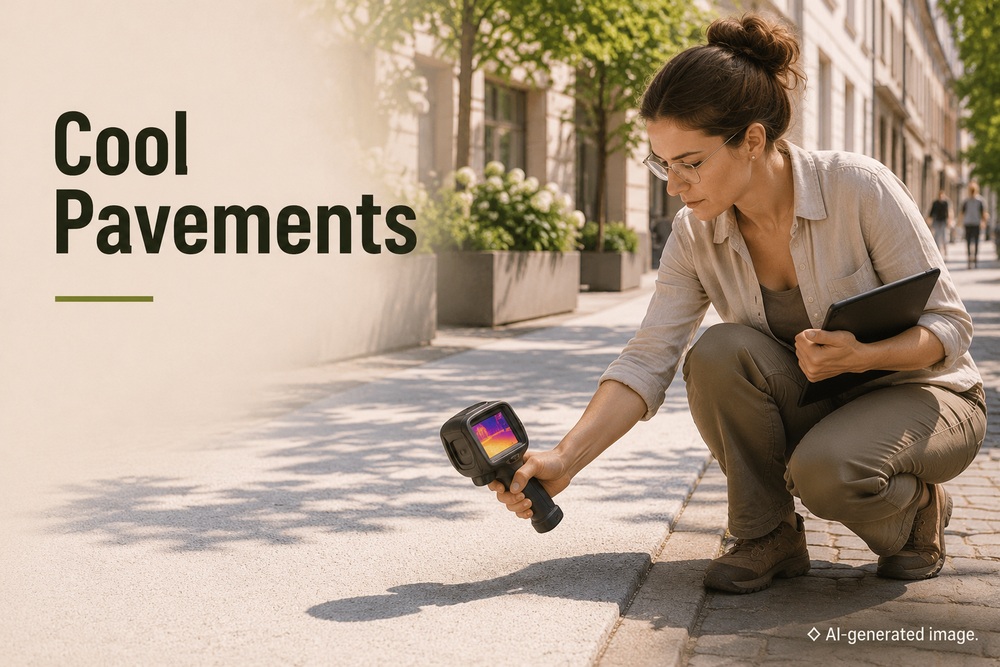
A pavement can be almost 10°C cooler than conventional asphalt and still make pedestrians feel hotter. It sounds contradictory, but the explanation lies in the difference between surface temperature and human heat exposure. A reflective road absorbs less solar energy, yet sends a larger proportion of sunlight back into the surrounding environment. Some of that radiation reaches people walking, standing or waiting beside the road.
This distinction matters when cities choose materials for streets, squares, pedestrian routes and public spaces. A surface that performs well in an infrared camera image does not automatically improve outdoor thermal comfort. The outcome depends on solar exposure, wind speed, surrounding buildings, shade and the amount of reflected radiation reaching the human body.
Field research in Vienna illustrates the problem particularly well. A yellow-pigmented asphalt section reached a midday surface temperature of 34.8°C, compared with 44.3°C for adjacent porous asphalt. However, its median Physiological Equivalent Temperature (PET) was 35.35°C, compared with 32.35°C above conventional asphalt during the same measurement campaign. The cooler surface produced a less comfortable pedestrian environment under those particular conditions.
For urban planners and road engineers, the practical lesson is straightforward: cool pavement must be assessed at pedestrian height, not just at ground level.
Why a Cooler Pavement Can Increase Radiant Heat Exposure
The central mechanism is solar reflectance, also known as albedo. It describes the proportion of incoming solar radiation reflected by a surface rather than absorbed by it. Albedo ranges from 0 to 1: a value close to zero indicates strong absorption, while a value closer to one indicates strong reflection.
Traditional dark asphalt absorbs a substantial amount of sunlight. Its surface temperature rises, and the heated material transfers energy to the surrounding air and emits longwave infrared radiation. This contributes to urban overheating, particularly where large paved areas have little vegetation or ventilation.
Reflective pavement changes that energy balance. Light-coloured aggregates, specialised binders and reflective coatings reduce the amount of solar energy absorbed by the road. The surface stays cooler, and less heat is stored within the pavement structure.
However, the reflected energy does not disappear.
A pedestrian standing above a bright surface receives radiation from several directions:
- Direct solar radiation arriving from the sun.
- Diffuse shortwave radiation scattered through the atmosphere.
- Reflected shortwave radiation coming from the pavement and nearby buildings.
- Longwave infrared radiation emitted by surrounding surfaces, including walls and roads.
A reflective pavement reduces some of the longwave radiation emitted by its cooler surface but can increase the shortwave radiation reaching the body. Whether the overall effect is beneficial depends on which contribution dominates.
The most important indicator here is Mean Radiant Temperature (MRT). It represents the combined radiant environment experienced by a person, rather than the temperature of one particular object. MRT is especially important in exposed urban spaces because direct sunlight and reflected radiation can create substantial heat stress even when the measured air temperature remains moderate.
Two other indicators are useful:
- PET (Physiological Equivalent Temperature) estimates how the combined outdoor conditions affect human thermal comfort by expressing them as an equivalent temperature under defined reference conditions.
- UTCI (Universal Thermal Climate Index) assesses outdoor thermal stress using air temperature, humidity, wind and mean radiant temperature.
Neither index is interchangeable with a standard weather-station reading. A street can record an air temperature of 30°C while a person standing in direct sunlight experiences considerably greater thermal stress.
The effect becomes particularly problematic under three conditions:
- Strong midday sunlight: the pavement receives substantial solar radiation and reflects more energy towards pedestrians.
- Low wind speed: limited air movement reduces convective cooling, allowing radiant heat exposure to have a stronger influence on comfort.
- Limited shade: people receive direct sunlight as well as reflected radiation from the ground and surrounding façades.
Consider a pedestrian crossing a wide, unshaded paved square on a hot afternoon. Replacing dark asphalt with a highly reflective coating may lower the temperature of the ground, but the person remains exposed to direct sunlight and receives additional reflected radiation from below. The result can be a cooler pavement without a meaningful improvement in personal comfort.
The situation changes under tree cover or beside a shaded building. Direct radiation is reduced, and the cooler pavement can contribute to a more comfortable local environment. Distance also matters: someone walking several metres away from the treated road will not necessarily receive the same reflected radiation as someone standing directly above it.
The important distinction is that reducing heat absorption by a material and reducing heat exposure for a person are two different engineering objectives. A successful design must address both.
What Field Measurements in Vienna and Phoenix Reveal
Laboratory testing often makes reflective pavement look particularly attractive. A sample is exposed to controlled solar conditions, and its surface temperature is compared with conventional asphalt. The difficulty is that laboratory measurements cannot fully reproduce the interaction between sunlight, wind, buildings, vegetation and human movement.
Field experiments provide a more useful picture.
One particularly relevant European example comes from a controlled pavement-testing site in Vienna, Austria. Researchers compared four asphalt variants installed in sections measuring approximately 20 metres long and 3.5 metres wide. The site was used by pedestrians and cyclists.
The tested materials included conventional asphalt, light-coloured asphalt, yellow-pigmented reflective asphalt and porous asphalt.
The measured solar reflectance values were:
| Pavement type | Measured albedo |
|---|---|
| Yellow-pigmented asphalt | 0.229 |
| Light-coloured asphalt | 0.188 |
| Conventional asphalt | 0.155 |
| Porous asphalt | 0.106 |
The yellow-pigmented material reflected the largest proportion of incoming solar radiation.
During the midday measurement campaign on 19 August 2025, the surface temperatures were:
- Yellow-pigmented asphalt: 34.8°C.
- Light-coloured asphalt: 38.7°C.
- Conventional asphalt: 38.5°C.
- Porous asphalt: 44.3°C.
The difference between the coolest and hottest surfaces was 9.5°C.
However, the pedestrian-level thermal comfort results told a different story. The median PET was 35.35°C above the yellow-pigmented asphalt and 32.35°C above conventional asphalt. The reflective variant also recorded a higher proportion of observations in the study’s hot-stress category.
Wind speed at pedestrian height averaged approximately 0.87 m/s during this measurement period. These relatively calm conditions limited convective cooling and increased the importance of radiant heat exposure.
The results need to be interpreted carefully. The PET comparison came from a short midday campaign at a semi-open site, not a multi-year study of a dense urban street. A subsequent validation campaign in July 2026 reproduced the general ranking under different wind conditions, but the absolute thermal comfort values changed.
That difference is important. A reflective material does not have one fixed pedestrian comfort outcome independent of weather.
A separate field assessment in Phoenix, Arizona, published in 2026, found another version of the same trade-off. Reflective pavement reduced average surface temperatures by approximately 3.0°C compared with conventional asphalt. Near-surface air temperatures were only around 0.2–0.3°C lower during midday and afternoon measurements, while mean radiant temperature increased by approximately 2.4–3.0°C during the day.
The Phoenix findings demonstrate why measuring only air temperature is insufficient. A small reduction in air temperature does not necessarily compensate for a larger radiant heat load.
There are also field studies showing that reflective pavements can improve pedestrian conditions overall. Research conducted in Pacoima, California, recorded predominantly beneficial changes in pedestrian thermal comfort, although the results varied with location, weather and measurement method. This is an important qualification: high reflectance is not automatically harmful, just as lower surface temperature is not automatically beneficial.
Material ageing introduces another complication.
In the Vienna experiment, the yellow asphalt had achieved a laboratory albedo of approximately 0.46. After around 11 months of environmental exposure, its measured field albedo was approximately 0.229. Dust, surface contamination, wear and other ageing processes can substantially reduce reflectivity.
This creates a practical procurement problem. A manufacturer may advertise impressive initial performance, but the city ultimately needs to know how the pavement performs after traffic, weather and routine maintenance.
Porous asphalt also deserves a closer look. Its open structure can support water infiltration and evaporative cooling, but that mechanism depends on available moisture. In the Vienna experiment, the porous section had experienced 13 days without rainfall before the first campaign. Without sufficient water to evaporate, the expected cooling effect was absent.
The practical conclusion from these experiments is that field performance, not laboratory appearance, should determine material selection. Surface temperature, radiant exposure, moisture availability and long-term reflectivity all need to be considered together.
How to Choose Cool Pavements Without Making Pedestrian Areas Hotter
For Polish cities, the most sensible approach is to treat pavement selection as part of a wider public-space design rather than as an isolated material upgrade.
A reflective coating may be appropriate on a broad, sun-exposed road surface with limited pedestrian activity. The same coating may be a poor choice for a bus stop, an exposed school forecourt or a narrow pedestrian route where people remain in direct sunlight.
The decision should start with the location and its actual use.
Prioritise shade in places where people spend time
If pedestrians are exposed to direct sunlight for long periods, shade should usually come before increasing pavement reflectance.
Street trees, properly designed canopies and shaded waiting areas reduce direct solar exposure. Trees also provide evapotranspiration, which helps cool the surrounding microclimate when adequate water is available.
For example, a Polish municipality redesigning a paved square beside a public transport interchange should first identify where passengers queue and wait. Providing shade over those areas can reduce direct radiant exposure more reliably than covering the entire square with highly reflective material.
Tree planting requires sufficient soil volume, drainage and maintenance. A few small trees placed in undersized pits will not provide the same results as a continuous, healthy canopy.
Use reflective pavement selectively
High-reflectance materials make more sense where their surface-cooling benefits outweigh the additional radiant exposure.
Potentially suitable locations include:
- Large road surfaces with limited pedestrian access.
- Parking areas with low pedestrian occupancy.
- Service roads and selected industrial surfaces.
- Open paved areas where people do not remain for long periods and where reflected radiation does not create additional exposure for nearby buildings or walking routes.
The decision becomes more difficult when a reflective road runs directly beside an unshaded pavement. In that situation, the reflected energy can reach pedestrians even if they are not standing on the treated surface.
For heavily used pedestrian areas, moderate reflectance may be a better compromise than the brightest available coating. Materials with selective near-infrared reflectance are also worth considering where their optical performance, durability and visible glare characteristics have been properly tested.
Choose permeable materials only when water management supports them
Permeable paving can address stormwater runoff and support evaporative cooling. However, these are separate performance objectives.
A porous surface without available moisture cannot maintain evaporative cooling during prolonged dry periods. Clogged pores also reduce infiltration, while inadequate maintenance can gradually undermine the drainage function.
Before selecting porous asphalt or permeable paving blocks, check:
- Whether rainwater can be stored or directed into the pavement structure.
- Whether the underlying soil and drainage system can accept the water.
- Whether the surface can be cleaned without damaging its structure.
- Whether the expected moisture supply is sufficient during summer heatwaves.
The Stockholm system, which combines permeable paving, structural soil and street trees, offers a useful design principle: water management and vegetation should be planned together rather than treating permeable pavement as a standalone cooling product.
For Polish projects, freeze-thaw cycles, winter maintenance and de-icing salts also need to be included in the material specification.
Measure pedestrian comfort before approving a full installation
A pilot project should compare the proposed pavement with an untreated reference surface under similar weather conditions.
At a minimum, the measurement programme should include:
| Parameter | What it tells the designer |
|---|---|
| Surface temperature | How much the pavement heats up |
| Solar reflectance (albedo) | How much incoming solar radiation is reflected |
| Air temperature at approximately 1.1 m | Conditions near the standing pedestrian’s body |
| Mean radiant temperature | Combined radiant exposure from the surroundings |
| PET or UTCI | Overall outdoor thermal stress |
| Wind speed and humidity | How effectively the body can lose heat |
| Evening temperatures | Whether reduced daytime heat storage improves later conditions |
Air-temperature sensors must have appropriate radiation shielding and, ideally, aspiration. Otherwise, direct and reflected sunlight can heat the sensor itself and distort the reading.
Measurements should cover the period of greatest pedestrian exposure, generally the sunny afternoon hours, rather than relying on one morning reading. Several hot, clear days provide a more reliable assessment than a single measurement session.
The pilot should also be inspected after the first summer and winter. Check whether reflectivity has declined, whether the coating has peeled or worn, and whether the surface has retained adequate wet skid resistance.
For Polish roads and pedestrian infrastructure, this last point is particularly important. A treatment that improves summer thermal performance but creates a slippery surface after rain is not an acceptable improvement.
Evaluate lifecycle performance, not just the initial specification
A pavement’s performance changes with use. Traffic abrasion, accumulated dust, road salt, cleaning operations and weathering all affect its surface properties.
The Vienna results provide a useful warning: the yellow asphalt’s measured field reflectance was roughly half its initial laboratory value after approximately one year.
That does not mean every reflective pavement will lose reflectivity at the same rate. It does mean that initial laboratory figures should never be treated as guaranteed long-term performance.
Before approving a large installation, require:
- Documented initial solar reflectance.
- Evidence of performance after environmental ageing.
- Wet slip-resistance test results.
- Resistance to abrasion, freeze-thaw conditions and de-icing salts.
- A realistic cleaning and inspection plan.
- A clear comparison of maintenance costs over the expected service life.
A slightly less reflective material that retains its properties and provides better pedestrian comfort may be a better investment than an initially impressive coating that deteriorates quickly.
Frequently Asked Questions
Can cool pavement make pedestrians feel hotter even when the road is cooler?
Yes. Reflective pavement absorbs less solar energy but sends more shortwave radiation back towards pedestrians. Under direct sunlight and low-wind conditions, this can increase mean radiant temperature and overall thermal stress.
Is white asphalt always the best option for reducing urban heat?
No. High reflectance can increase glare and pedestrian radiant exposure. The best material depends on the location, surrounding buildings, shade, wind conditions and how intensively people use the space.
Does porous pavement provide cooling throughout the summer?
Not necessarily. Its evaporative cooling effect depends on moisture. During extended dry periods, the surface may lose this benefit, particularly if there is no rainwater storage or irrigation system.
Which measurement is more important: surface temperature or air temperature?
Neither is sufficient on its own. Surface temperature describes the pavement, while air temperature describes the surrounding air. For pedestrian comfort, mean radiant temperature and an index such as PET or UTCI are also necessary.
Should reflective pavement be installed near bus stops and pedestrian crossings?
Only after assessing the additional radiant exposure. These are locations where people often stand still, have limited access to shade and cannot easily avoid direct sunlight. Shade and carefully selected surface materials should take priority.
Can reflective pavements reduce nighttime urban heat?
They can reduce daytime heat storage and therefore limit some of the heat released after sunset. However, the resulting air-temperature benefit is generally smaller than the surface-temperature change and depends on the scale of installation, local wind and surrounding urban geometry.
The first decision should not be which reflective coating to purchase. It should be where pedestrians experience the greatest heat exposure between midday and late afternoon. Map those locations, identify the missing shade, and measure MRT or PET at pedestrian height. Only then select a pavement material and test it against an untreated reference. This sequence prevents a common design mistake: solving a surface-temperature problem while leaving the people using the space exposed to even greater heat.